
Electric vs. Rough-Terrain Scissor Lifts: Which to Pick
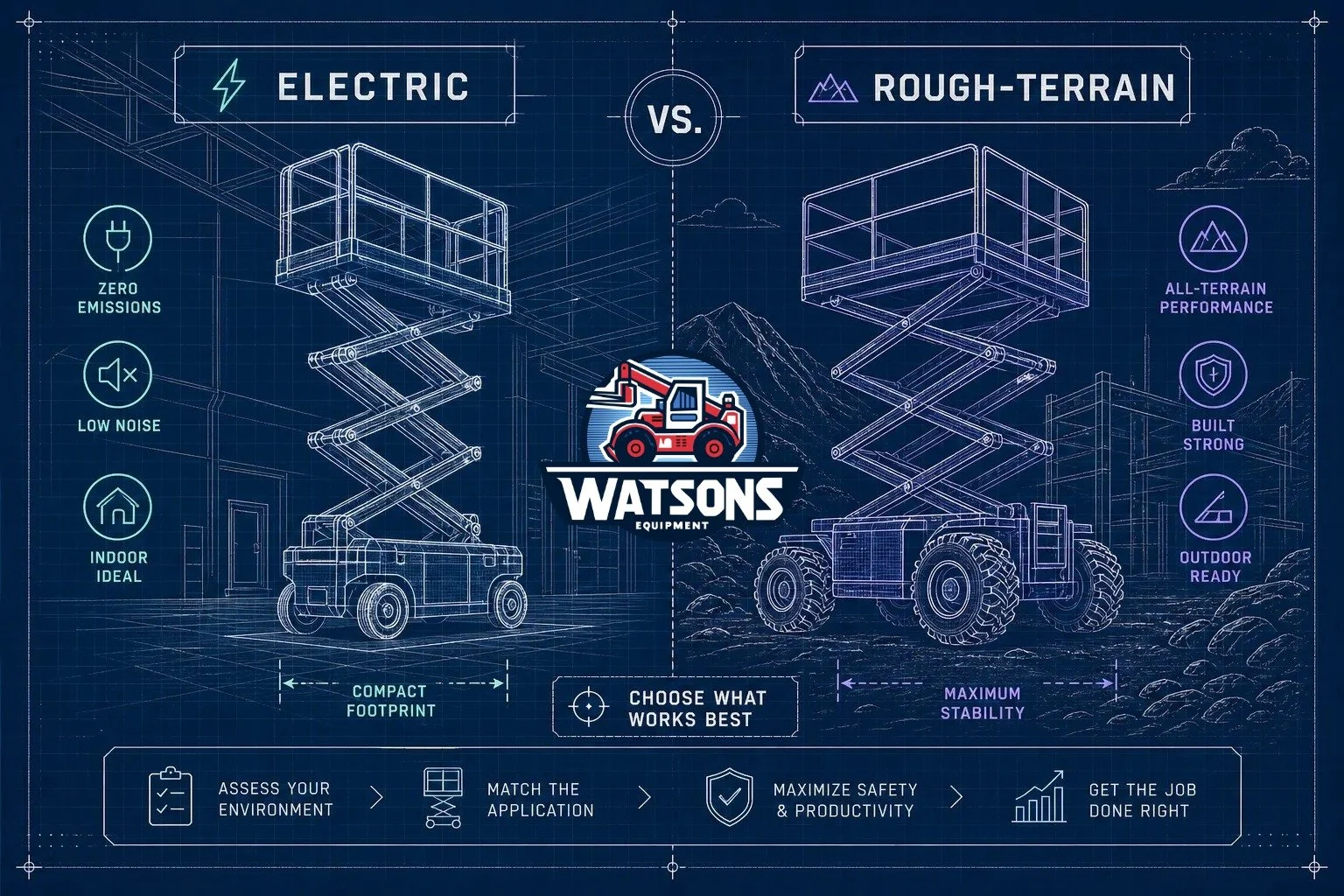
Electric scissor lift and rough-terrain scissor lift shown side by side, highlighting the differences in tires, ground clearance, size, and jobsite use for indoor and outdoor applications.
Electric vs. Rough-Terrain Scissor Lifts: Which to Pick
When comparing an electric scissor lift vs rough terrain models, the machines look like cousins on paper. Same basic machine. Same scissor mechanism. Similar height ranges. But put the wrong one on the wrong jobsite and you'll figure it out fast, usually after the tilt sensor kills your platform, after diesel exhaust sets off the building's air quality alarms, or after a 10,000-pound RT machine leaves tire tracks across a freshly polished warehouse floor.
This is the most common question we hear at Watsons Equipment: "Which scissor lift do I actually need?" We sell both types daily, factory-new from Skyjack and JLG, to construction crews, facilities managers, agricultural operations, and government agencies. After years of those conversations, the answer always comes down to the same four factors: where the work is happening, how high and heavy the job is, what the energy situation looks like on site, and what the regulations require. This article walks through all of it.
Electric Scissor Lift vs Rough Terrain: The Core Difference
The most common misconception is that a rough-terrain lift is just a bigger, beefier version of an electric scissor lift. That's not what's happening. These are fundamentally different machines designed for fundamentally different environments. The design intent shapes everything: the chassis, the tires, the drive system, the weight, the profile, and the power source.
Electric slab lifts are engineered for smooth, level, finished surfaces, warehouses, factories, hospitals, shopping centers, finished concrete floors. They run on non-marking tires to protect floors, produce zero exhaust, operate quietly enough for occupied buildings, and carry a narrow profile that fits tight aisles. Everything about the design assumes a controlled indoor environment.
RT scissor lifts are built from scratch for unpredictable outdoor ground, construction fill, compacted soil, gravel, mud, grass, slopes. They run four-wheel drive systems, carry high ground clearance, mount large pneumatic or foam-filled tires, and sit on heavier chassis designed to stay stable when the ground isn't cooperating. Electric RT models exist as a middle option, offering outdoor capability with zero exhaust, but they're still outdoor construction machines. Calling one "electric" doesn't make it an indoor substitute.
There's also a category worth noting: all-terrain scissor lifts. These are sometimes marketed separately from standard RT machines and are designed to handle the most demanding outdoor surfaces, including steep grades and highly uneven terrain. They differ from both slab lifts and conventional RT lifts in chassis design and gradeability, so if a supplier uses that term, confirm the specs match your site conditions before committing.
Electric Scissor Lift vs Rough Terrain: Terrain Capability
Indoor Stability (Battery-Powered Slab Lift)
Electric slab lifts belong on finished concrete, smooth asphalt, and level paved areas. Their low ground clearance makes ruts, debris, curbs, and thresholds genuinely hazardous. The tilt sensors built into these machines will disable lift functions the moment the surface tilts meaningfully, because that's exactly what they're designed to do. These are level-ground machines, full stop. Before putting one to work, you sweep debris, check floor load ratings, inspect for voids, and make sure the travel route from point A to point B doesn't include anything that would stop the lift cold.
Outdoor Stability (RT Scissor Lift)
RT lifts operate on compacted soil, gravel, mud, grass, and unfinished construction surfaces. Four-wheel drive and oscillating axles keep the machine stable on terrain that would stop a slab lift before it even got started. One number that trips up a lot of buyers: RT gradeability figures, typically around 25 to 30 percent, apply to lowered-travel conditions only. The allowable slope for elevated working is much tighter, roughly 3 degrees front-to-back and 1.5 degrees side-to-side depending on the model. Never judge slope by eye on an outdoor jobsite. Use an inclinometer, and if the tilt alarm activates, stop immediately.
Platform Height and Capacity: Matching the Machine to the Job
Height and capacity specs matter more than most buyers realize, because working height isn't the same as platform height. Working height assumes a standing operator reaching upward, typically adding 6 to 7 feet above the platform. Keep that in mind when you're sizing the machine to the job.
Electric slab models from Skyjack run from about 19 to 45 feet of platform height. The SJ3219 E tops out at 18 feet 6 inches with 500 lb capacity, while the SJ5545 E reaches 45 feet with 770 lb capacity. JLG's ES-series electric models cover similar ground. RT models push further. JLG's current RT lineup runs from the RT2669 at 26 feet 2 inches with 1,500 lb capacity up to the RT5394 at 53 feet with 1,500 lb capacity. The RT3394 is a standout with 33 feet of platform height and 2,250 lb rated capacity.
Capacity covers everything on the platform: workers, tools, materials, accessories. Not just people. For multi-worker crews hauling pipe, cladding, or heavy materials, the higher capacity of RT models is often the deciding factor. For solo or two-person work in a finished facility with tools and light materials, the slab lift handles it cleanly. Skyjack and JLG both publish verified specs for every model, and getting those numbers in front of you before you order matters.
Electric Scissor Lift vs Rough Terrain: Costs and Runtime
Runtime and Charging (Battery-Powered Scissor Lift)
Electric scissor lifts run roughly 4 to 6 hours per charge on typical duty cycles. Recharging takes 4 to 10 hours depending on the charger and battery type, which means overnight charging is the realistic plan for most operations. If you're running multi-shift work, factor in spare batteries or fast chargers, both add cost. Lead-acid battery packs on Skyjack and JLG slab lifts typically last 3 to 5 years with proper maintenance, with replacement running around $1,000 to $1,400 for a conventional 24V pack. Lithium options last longer, around 8 to 12 years, but cost substantially more upfront.
Fuel and Maintenance (Diesel RT Scissor Lift)
Diesel RT lifts run 8 to 12 hours per tank and refuel in 5 to 15 minutes. For jobs where downtime is the enemy, that's a real advantage. The operating cost gap is significant, though. Electric lifts run approximately $0.15 to $0.75 per hour in energy cost with $500 to $1,500 in annual maintenance. Diesel RT lifts run $4.50 to $6.00 per hour in fuel with $1,500 to $4,000 in annual maintenance for engine servicing, filters, fluids, and heavy-duty tire wear.
At 500 operating hours per year, electric total costs land around $1,500 to $4,000 annually. Diesel RT lands around $3,000 to $6,000. Electric wins on operating cost when it can recharge between shifts. When continuous uptime on rough outdoor ground is the priority, diesel earns its higher operating cost. New electric slab models from Skyjack run $13,700 to $30,000; JLG electric models run $16,000 to $35,000. New RT machines start around $35,000 to $40,000 and climb past $60,000 to $70,000 for heavy-duty configurations.
Noise, Emissions, and What the Regulations Actually Require
Electric lifts operate at roughly 55 to 75 dB with zero tailpipe emissions. That's why they're the default choice for hospitals, schools, occupied retail spaces, and any building where air quality and noise matter. Diesel lifts run 75 to 95 dB and produce CO, NOx, and particulate matter. Running diesel equipment in an enclosed or poorly ventilated space isn't a gray area. It's a documented carbon monoxide hazard, and open doors with fans are not a substitute for proper mechanical ventilation.
Some green building specifications and local air quality ordinances prohibit combustion equipment indoors outright, regardless of ventilation. If your project spec sheet includes those requirements and you show up with a diesel lift, you have a problem that can't be solved on site.
On the regulatory side, OSHA doesn't simply draw a line that says "electric inside, diesel outside." Under OSHA's construction regulations, scissor lifts are treated as mobile scaffolds under 29 CFR 1926.451 and 1926.452(w), not as aerial lifts. The lift must match the manufacturer's instructions, terrain limits, and the employer's site-specific hazard assessment. Operators need training and authorization on the specific machine, not just any scissor lift in general, and pre-use inspections are mandatory and must be documented. Any lift with defective guardrails, tires, brakes, or controls comes out of service immediately.
For diesel lifts operating near occupied areas, CO exposure needs to be evaluated and air monitoring implemented. A CO alarm is a warning device, not a ventilation strategy. Noise exposure above 85 dBA as an 8-hour time-weighted average triggers OSHA's hearing conservation requirements, a point directly relevant to diesel RT operations in active work zones.
How to Pick the Right Scissor Lift for Your Specific Job
Four questions settle this faster than any spec sheet comparison.
Where is the work happening: smooth indoor floor or unpredictable outdoor ground?
What height and capacity does the crew actually need?
Is charging infrastructure available between shifts, or does the job demand diesel uptime?
Are there emissions restrictions, noise ordinances, or occupied-building requirements on site?
If the work is indoors on a smooth floor and emissions matter, the answer is a battery-powered slab lift every time. If the work is on uneven outdoor ground with heavy loads and long shifts, the answer is an RT lift, diesel or electric RT depending on what the site's emissions requirements demand. The only time the decision gets complicated is when you're working on a flat outdoor slab near a noise-sensitive environment. In those cases, electric often wins even outdoors, provided runtime and surface conditions hold up.
Watsons Equipment carries both electric scissor lifts and rough-terrain scissor lifts as a factory-authorized dealer for Skyjack and JLG. Both brands cover the full range: compact indoor electrics starting under $14,000 on the Skyjack side, up through heavy-duty RT configurations that push past $60,000. Same-day quotes are available by phone. No waiting on a sales cycle to find out what a machine costs. We ship nationwide, so your location isn't a barrier to getting the right equipment fast.
The Bottom Line
Electric and rough-terrain scissor lifts don't compete with each other. They solve different problems. An electric slab lift on gravel is a safety problem waiting to happen. A diesel RT lift in a finished warehouse is a floor-damage and air-quality problem.
When weighing electric scissor lift vs rough terrain options, the right call is almost always clear once you know where the work is, what the crew needs to carry, what the site's energy situation looks like, and what the regulations require. Getting this decision right costs nothing. Getting it wrong costs time, money, and can cause a serious safety incident. If you're still not sure after working through those four questions, that's exactly what our team at Watsons Equipment is here for. Reach out for a same-day quote and tell us about the job. We'll point you to the right machine from the right brand without the runaround.
