
Buying a New Aerial Lift: Which Type Fits Your Job?
Buying a New Aerial Lift: Which Type Fits Your Job?
Buying a new aerial lift is one of the more consequential equipment decisions a contractor or government buyer makes, and it's where most people stall. The decision matrix is real: boom or scissor, electric or diesel, new or used, buy or rent. Stalling costs money, either in the wrong machine, a bad used unit, or a rental bill that adds up to more than ownership would have. This guide cuts through that. The goal isn't to find the cheapest option; it's to match the right machine to your actual job.
At Watsons Equipment, our team fields these exact questions from contractors and government buyers every week. As an authorized dealer for JLG, Genie, Skyjack, and SkyTrak, we've seen every version of this decision go right and wrong. What follows is the framework we walk buyers through: lift type, specs, cost math, and next steps.
Which aerial lift type actually fits your job?
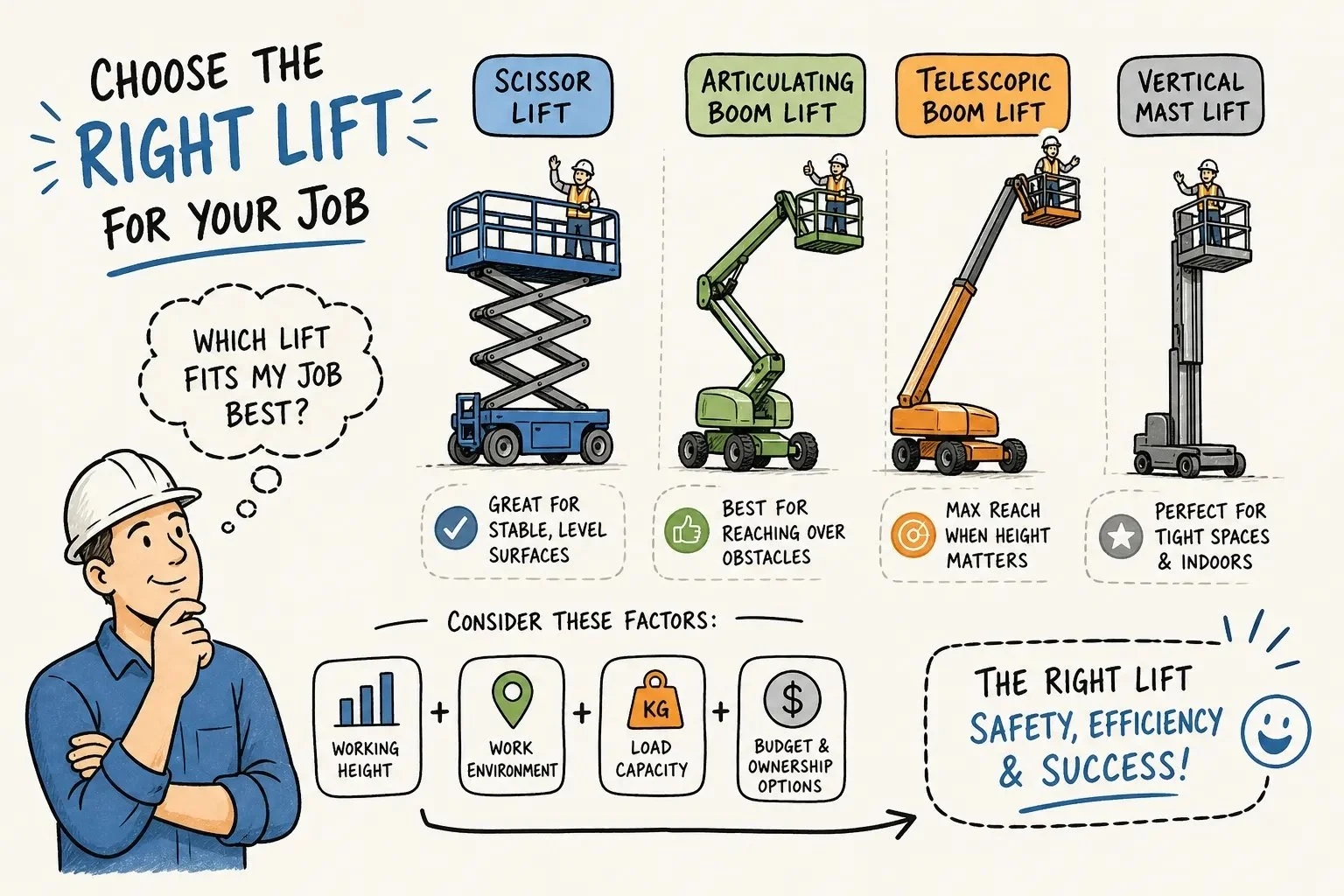
There are four main categories of aerial work platforms (AWPs), and each one solves a different access problem. Getting this choice right before you look at a single price tag saves a lot of headache later.
Articulating and telescopic boom lifts: who needs what
The single question that separates these two is whether the path to your work point is clear. If you need to work up, over, and around obstacles, pipe racks, façades, tight indoor plants, machinery in the way, an articulating boom is the right tool. It bends at the knuckle, which lets operators navigate around things rather than just above them. Telescopic booms are for maximum straight-line reach in open areas: bridge inspection, high-rise exteriors, stadium work, utility towers. They go farther and higher, but they need a clear approach to get there.
Price anchors for new units: 30, 40 ft boom lifts typically run $25,000, $45,000, while high-spec or high-reach models can push well past $100,000. Large units in the 100, 150 ft range regularly list above $300,000, $450,000 new. These figures reflect typical U.S. dealer list prices for current-model-year equipment; actual quotes vary by configuration and region.
Scissor lifts and vertical mast lifts for vertical-only access
Scissor lifts are the right call when the work is straight up and a stable, larger platform matters more than reach. Interior finishing, HVAC, ceiling grid work, warehouse maintenance, these are scissor-lift jobs. Vertical mast lifts are the compact, lowest-cost option for tight indoor spaces where height is modest and the footprint needs to be minimal. Entry-level electric scissor units start around $12,000, $14,000 new, based on current dealer pricing for standard-platform models. Neither of these machines is the answer if you need to reach over or around something.
Telehandlers: when the job is moving materials, not just people
A telehandler isn't an aerial work platform in the traditional sense. It's a material-handling machine built to place heavy loads at height and distance on a construction site or farm. If the job involves elevating workers to a precise access point, a boom or scissor is the better tool. If the job is stacking pallets, placing trusses, or moving hay bales on rough ground, a telehandler earns its place on the equipment list.
Specs to check when buying a new aerial lift
Knowing the lift type gets you to the right category. Knowing whether a specific model actually works on your jobsite is the next step. Skipping this part is how buyers end up with a machine that technically reaches the height they need but can't get to the work area.
Platform height, working height, and horizontal reach
Platform height and working height are not the same, and manufacturers don't always define them consistently. Working height typically adds about five to six feet to the platform height to account for a standing operator's reach. Comparing the wrong number across brands will lead you to buy a machine that falls short. For boom lifts, horizontal reach matters just as much as height. A work point that's 40 feet up and 20 feet out from where the machine can park requires a machine that can handle both dimensions, not just the vertical.
Power source, terrain rating, and weight limits
Electric units are quieter, cheaper to run, and emission-free, the right choice for indoor work. Diesel and rough-terrain configurations cost more upfront and more per year in maintenance, but they're the only viable option for uneven outdoor sites where battery machines can't operate safely.
Regarding rated load capacity: OSHA requires that manufacturer limits never be exceeded. A practical planning rule is 250 lbs. per person plus tools and materials. If your crew and gear push against that number, factor it into the spec comparison before you buy.
Transport dimensions and site access
Stowed height, stowed width, machine weight, and axle load ratings determine whether a lift can pass through a doorway, fit in an elevator, travel legally on a trailer, or roll across a concrete slab without exceeding the floor load rating. These numbers are easy to overlook when the focus is on platform height and reach, but they decide whether the machine can physically get to the work area. Get these specs on paper before any purchase conversation goes further.
New vs. used vs. rental: the honest cost breakdown
Used equipment looks like a deal until you do the math, and that's not a moral argument, it's just arithmetic. Here's what each option actually includes.
What you're really getting when you buy new
A new aerial lift comes with a full manufacturer warranty, current ANSI and OSHA safety compliance built in, zero unknown service history, and maximum residual value for financing or resale. JLG, for example, offers a one-year full machine warranty plus five years on structural components for aerial work platforms, and their telehandlers carry 24-month or 2,000-hour powertrain coverage on top of that. Authorized dealers like Watsons Equipment activate and support those warranties; a general reseller cannot. That distinction matters when a machine goes down mid-project and the clock is running.
The real cost of used equipment
A used unit priced well below new can close that gap quickly. Unknown maintenance history, potential compliance gaps with current standards, worn wear parts, and zero warranty coverage are the starting point for every used purchase. One major hydraulic repair or a failed inspection can eliminate the price advantage entirely. A well-maintained new lift has a realistic service life of 15, 20 years; buying new and maintaining it properly spreads the purchase cost across a timeline that often makes the per-year cost more competitive than the sticker suggests.
When rental makes sense (and when it doesn't)
Rental is rational for a one-off project with no repeat need. For contractors who use aerial access equipment on multiple jobs per year, the math usually favors ownership. A useful rule of thumb: if you're renting the same category of lift more than four or five times annually, run a side-by-side comparison of your annual rental spend against the annualized cost of owning, most buyers find ownership wins by the sixth or seventh rental event.
What it actually costs to own and maintain a new aerial lift
Total cost of ownership is the number most buyers don't calculate before they buy. Here's what goes into it.
Electric vs. diesel: the annual maintenance gap
Electric scissor lifts typically run $600, $900 per year in scheduled maintenance. Diesel and rough-terrain boom lifts run $1,500, $2,200 per year, and that's before tires, a major recurring cost for outdoor machines. Battery replacement on electric units runs roughly $800, $1,200 for a full set, which is a predictable capital expense you can budget for rather than absorb as an emergency. Industry maintenance data suggests electric units require roughly 40, 50% less maintenance overall compared to diesel, which directly reduces unplanned downtime on active jobs.
OSHA inspection requirements and what to budget for compliance
Pre-shift inspection is required before every workday, that's on the operator, before the machine moves. Frequent inspections happen approximately every 90 days or 150 hours. Annual inspections by a manufacturer-authorized technician are standard practice and are often required for contract compliance on government and commercial job sites. Build these into the ownership budget from day one. Skipping inspections creates liability that no warranty covers, and some job sites require documented proof of current inspection before a machine is allowed on-site.
On the training side, OSHA 1926.453 requires that only authorized, trained persons operate aerial lifts, that controls are tested before daily use, and that boom-lift operators use an appropriate fall protection system. There's no single OSHA-issued license for operators, but buyers need to have training records, competency documentation, and employer authorization on file for every operator.
Why buying a new aerial lift protects your bottom line long term
The warranty, compliance documentation, and residual value that come with a new machine aren't features, they're financial protection. A new lift from an authorized dealer comes with the manufacturer's full structural and systems warranty, which covers the repair costs that used equipment owners absorb out of pocket. That's a real number, not a hypothetical. Authorized dealer status also means access to OEM parts and manufacturer technical support, which keeps downtime short when something needs attention.
New aerial lifts are built to current ANSI and OSHA standards. That matters because some job sites, especially government and federal projects, require proof of current-spec equipment for site access and contract compliance. Starting with a compliant machine eliminates a category of risk entirely. It also keeps financing cleaner: new equipment holds more predictable residual value, which matters if the business direction changes and resale becomes the plan.
Getting your quote and buying the right way
Not every aerial lift dealer is authorized by the manufacturers they sell. Authorized dealer status means the dealer can activate manufacturer warranties, provide current-spec documentation, and access OEM parts and technical support. Watsons Equipment is an authorized dealer for JLG, Genie, Skyjack, SkyTrak, and Wanco, which is the difference between buying equipment and buying backed equipment.
Watsons Equipment carries a full lineup of new boom lifts, scissor lifts, telehandlers, vertical mast lifts, and material handling equipment, and aims to provide same-day quotes on most configurations. For government buyers, Watsons Equipment holds SDVOSB and California DVBE certifications, which can support set-aside procurement objectives, specific compliance requirements vary by agency and solicitation, so confirm fit with your contracting officer. Call with your job specs: platform height, site conditions, power source preference, and terrain.
Frequently asked questions about buying a new aerial lift
What should I check when buying a new aerial lift?
Start with lift type, boom, scissor, telehandler, or vertical mast, matched to your specific access challenge. Then confirm platform height, working height, horizontal reach (for booms), load capacity, power source, and transport dimensions. Finally, verify the dealer's authorization status with the manufacturer so the warranty is fully activated and supported.
Is buying a new aerial lift better than renting long term?
For most contractors using aerial access equipment on four or more jobs per year, ownership is more cost-effective than ongoing rental. The annualized cost of a new machine, factoring in maintenance and warranty coverage, typically beats the cumulative rental spend within the first few years of regular use.
What makes an authorized dealer different from a general reseller?
An authorized dealer, like Watsons Equipment for JLG, Genie, Skyjack, SkyTrak, and Wanco, can activate the manufacturer's warranty, supply OEM parts, and provide access to factory technical support. A general reseller can sell the machine but cannot deliver those protections, which means any repair cost during the warranty period falls on the buyer.
The decision isn't complicated when you have the right framework
When buying a new aerial lift, the framework is straightforward: match the lift type to the access challenge, confirm the specs against the site, and purchase from an authorized dealer so the investment is protected by a warranty, compliance documentation, and real manufacturer support.
For contractors and government buyers who need reliable, compliant machines on tight timelines, a used unit with unknown history is a risk that rarely pencils out. The per-year cost of a well-maintained new lift, financed or purchased outright, is more competitive than the sticker price suggests once you account for warranty coverage, service life, and avoided repair costs.
If you're ready to move forward, reach out to the Watsons Equipment team directly. Give us the job specs, the site conditions, and the platform height you need, and we'll work to get a quote back to you the same day.
When you’re ready to invest, Watsons Equipment has the expertise, inventory, and nationwide reach to get you the right lift quickly.
