
How Portable Light Towers Improve Construction Site Safety
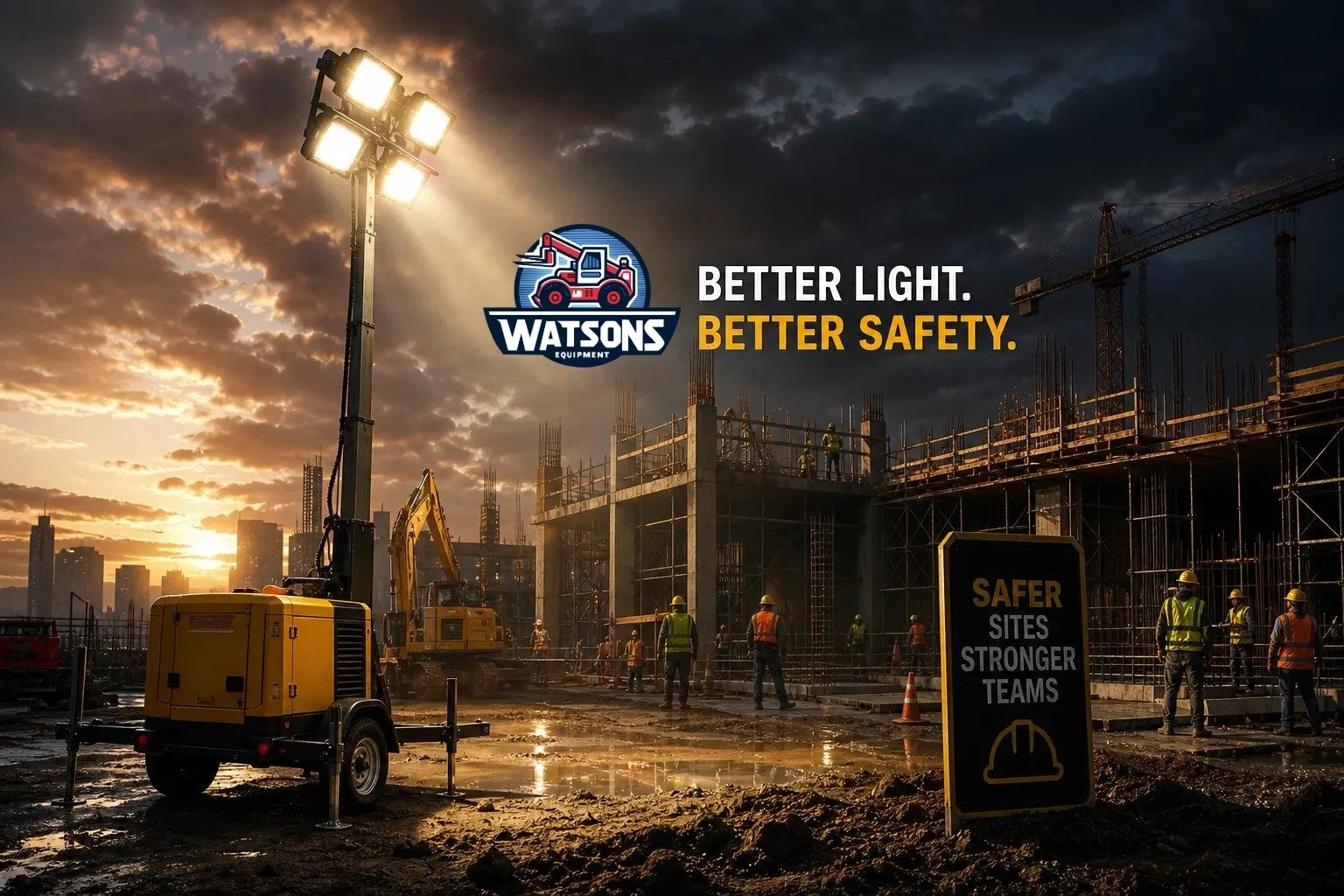
Portable construction light tower illuminating an active jobsite at dusk with workers and heavy equipment, highlighting improved visibility and safety.
How Portable Light Towers Improve Construction Site Safety
How do portable light towers improve construction site safety? Construction doesn't stop when the sun goes down. Neither do the hazards. After dark, every risk that exists on a daytime site becomes harder to see, harder to react to, and harder to survive. Falls, struck-by incidents, vehicle collisions, none of these are nighttime-only problems. They're visibility problems.
That distinction matters. Visibility, fatigue, and reduced alertness are major contributing factors to nighttime construction risk. Portable light towers are one of the most effective visibility interventions available on an active worksite. This guide covers how they reduce incidents, what OSHA actually requires, how to deploy them correctly, and how to choose the right type for your site conditions.
If you're sourcing towers for an upcoming project, Watsons Equipment, a veteran-owned, factory-authorized Wanco dealer, can get you a same-day quote on factory-new units shipped anywhere in the U.S.
Why Poor Visibility Is the Real Culprit Behind Nighttime Construction Accidents
Darkness doesn't create new hazards. It amplifies every existing one. A floor opening is dangerous during the day; without adequate construction site lighting, it becomes invisible. A roof edge that a worker navigates safely in daylight becomes a genuine death risk when the site is lit by a single inadequate work light throwing hard shadows in every direction. The hazard doesn't change. The worker's ability to perceive and react to it does.
The Accident Types That Spike After Dark
Three categories drive most nighttime construction fatalities, and understanding each one makes the case for portable light towers and site safety clearer than any general argument can.
Falls. Falls account for 37.6% of all U.S. construction deaths, with 389 recorded in 2024 (Bureau of Labor Statistics). Falls to lower levels made up 60.8% of OSHA's Focus Four fatalities in 2023. Every one of those mechanisms, roof edges, unprotected floor openings, scaffold transitions, ladder misplacements, gets harder to manage when site lighting is inadequate.
Struck-by incidents. Struck-by incidents represent 23.2% of Focus Four fatalities (OSHA). A crane operator who can't clearly spot a spotter's hand signal, a worker who can't identify a load swinging toward them, a pedestrian in a shadowed exclusion zone. All of these are visibility failures dressed up as equipment incidents.
Vehicle collisions. Backing incidents account for roughly 45% of construction vehicle deaths, and a common thread in many of these events is the same: the operator couldn't see the worker, or the worker couldn't detect the equipment approaching.
Why Darkness Compounds Every Other Hazard on Site
Poor jobsite illumination doesn't just obscure physical hazards. It slows reaction time, makes hand signals useless, and accelerates fatigue during overnight shifts. Communication breaks down when workers can't see each other clearly. Hazards that are manageable in daylight become genuinely life-threatening after dark because the margin for error shrinks. The business case for investing in temporary worksite lighting isn't complicated: it's the difference between hazards your crew can perceive and manage, and hazards they encounter without warning.
How Do Portable Light Towers Improve Construction Site Safety on Active Worksites?
When workers can see hazards, exclusion zones, and each other, the accident chain is interrupted before it starts. Mobile light towers don't change the physics of a construction site. They change what everyone on that site can perceive and respond to, and that shift in awareness is where injuries get prevented.
Reducing Shadow Zones at the Highest-Risk Areas
The most dangerous spots on a night site are shadow zones: excavation edges, scaffold transitions, material laydown areas, and areas where equipment swings. A single tower planted in the middle of a site creates dramatic shadows around every obstacle, structure, and elevation change. Portable LED light towers deployed at the perimeter and cross-aimed from multiple directions significantly reduce those shadows by ensuring no single structure can block all the light at once.
Transportation research reports nighttime incident reductions in the range of 18 to 39% following improved roadway lighting (with some studies citing approximately 24% reductions in injuries and fatalities), according to summaries of Federal Highway Administration and IES lighting research. These are roadway and intersection studies rather than tower-specific construction data, but the underlying visibility mechanism, reducing the time workers and operators have to react, applies directly to construction work zones, where the same categories of accidents occur.
Keeping Vehicle Operators and Pedestrians Visible to Each Other
Vehicle-pedestrian conflicts rank among the most preventable construction fatalities. Visibility is a common and critical contributing factor, though procedural failures, training gaps, and traffic control deficiencies also play roles. Adequate mobile lighting allows truck and equipment operators to see designated pedestrian routes, exclusion zones, and worker positions. It also allows workers to spot approaching equipment and get clear. This addresses struck-by and runover incidents, two categories that OSHA consistently flags as preventable.
Lighting doesn't replace exclusion zones, spotters, or proximity warning systems. It makes all of them more effective by ensuring the people using them can actually see what's happening around them.
OSHA Lighting Requirements: What the Standard Actually Demands
Site supervisors generally know OSHA has lighting rules. The specific numbers are less well understood. The enforceable standard is 29 CFR 1926.56, Table D-3, which applies wherever work is in progress.
The Minimum Foot-Candle Requirements Under 29 CFR 1926.56
The table breaks down by area type:
Access ways, aisles, active storage areas, loading platforms, and excavation areas: minimum 3 foot-candles (approximately 32 lux)
General construction areas: minimum 5 foot-candles (approximately 54 lux)
Shops, indoor warehouses, corridors, and tunnels: minimum 10 foot-candles (approximately 108 lux)
First-aid stations and offices: minimum 30 foot-candles (approximately 323 lux)
The companion provision, 29 CFR 1926.26, requires illumination wherever work is in progress, not just in specific task areas.
Why Meeting the Minimum Isn't Always Enough
OSHA's numbers are a compliance floor, not a design target. Uniformity matters as much as average brightness. A single bright tower surrounded by dark zones creates dangerous light-to-dark adaptation issues for workers moving between areas. Per IES guidance, the acceptable maximum-to-minimum illuminance ratio across a work area is 10:1, with 5:1 preferred. A worker stepping from a well-lit area into a shadowed zone loses effective vision for several seconds while their eyes adjust. That's the window where incidents happen.
ANSI/IES RP-7 provides recommended levels for precision tasks like welding, rebar work, and electrical terminations that go well above OSHA minimums. Use the OSHA thresholds to stay compliant; use ANSI/IES guidance to actually protect your crew.
LED, Diesel, or Solar: Choosing the Right Type for Safety
The power source isn't just a cost or convenience decision. It affects glare behavior, heat and fire risk, operational noise, and runtime reliability. Each type has a legitimate role depending on site conditions.
Where Diesel-Powered Towers Still Earn Their Place
Diesel light towers deliver the highest sustained output, making them the right choice for large sites, severe weather, long overnight shifts, and remote locations where recharging isn't practical. The tradeoffs are real and shouldn't be minimized. Fuel handling, exhaust emissions, carbon monoxide risk in enclosed or partially enclosed areas, hot engine surfaces, and engine noise that can mask audible warnings are all genuine hazards. Proper ventilation, spill containment, and physical separation from combustible materials are non-negotiable when running diesel units. Switching from metal halide to LED fixtures on a diesel chassis doesn't change the combustion hazards underneath.
Why LED Is Winning on Most Modern Jobsites
Portable LED light towers offer instant-on performance, better color rendering, lower glare when properly aimed, no combustion heat, and significantly lower operating noise. These aren't just comfort features. Quieter equipment means verbal communication and audible safety signals stay intact on site. LED units eliminate refueling hazards entirely and produce no exhaust, making them the safer choice near occupied buildings, in partially enclosed spaces, and on urban sites where noise and emissions matter. For most commercial, industrial, and indoor-adjacent construction projects, they're the logical default.
Solar as a Perimeter and Security Lighting Option
Solar-powered LED towers work well for perimeter security lighting, laydown yards, and areas where moderate, consistent light levels are sufficient. They require careful planning around battery capacity, seasonal sunlight availability, and weather. Cloud cover, winter conditions, or shading from structures can reduce nighttime output or runtime. Match the application to the energy reality before committing to solar for a critical work zone. For supplemental or security coverage in predictable conditions, they're a practical, low-maintenance option.
Watsons Equipment carries light towers across all three configurations including new Hybrid Towers and can provide same-day quotes to buyers nationwide. As a factory-authorized Wanco dealer, Watsons Equipment is built to support the full range of jobsite lighting needs.
Placement and Mast-Height Strategies That Reduce Dark Spots and Glare
Most crews understand they need light towers. Few deploy them correctly. Wrong placement produces glare that's just as dangerous as darkness, blinding operators and drivers at the moments when visibility matters most.
Mast Height, Spacing, and Coverage Angle Guidelines
Getting the most out of portable light towers and site safety starts with correct deployment. Follow these guidelines:
Mast height: Deploy at full working height wherever utilities and structures allow. Heights of at least 5 meters (roughly 16 feet) improve uniformity and reduce localized brightness. Six meters or more is preferable for general construction areas.
Spacing: Use approximately 2 to 3 mast heights between towers to achieve overlapping coverage without creating dark transition bands.
Layout: For a central task area, position three or more towers roughly 120 degrees apart, cross-illuminating the work zone from multiple directions so no single structure creates a dominant hard shadow.
Beam angle: Keep beam axes within 60 degrees of vertical (no more than 30 degrees of tilt from straight down) unless the fixture is specifically designed for extended-throw glare control.
Overlap: Overlap adjacent coverage patterns by roughly 20 to 30 percent to eliminate dark bands between towers.
The Glare Problem Most Crews Ignore
A misaimed mobile light tower can blind a crane operator, a truck driver, or a worker in a critical position just as effectively as no light at all. Keep the beam axis at least 90 degrees from a driver's normal line of sight. Avoid aiming towers toward crane cabs, equipment operator positions, adjacent roadways, or reflective surfaces like wet pavement and metal decking.
After initial placement, walk the entire site at night from every operator and worker position to identify glare exposure points. Re-aim accordingly. This step gets skipped constantly, and it's one of the most important verification steps in the entire deployment process.
Pairing Light Towers With Surveillance for Complete Site Protection
Portable light towers don't just prevent accidents during active work. They enable the surveillance infrastructure that protects a site when the crew isn't present.
How Lighting Unlocks the Value of On-Site Cameras
Surveillance cameras are only as useful as the light they have to work with. Mobile lighting towers eliminate the low-light conditions that produce grainy, unusable footage. Well-lit sites with visible camera coverage deter unauthorized entry, equipment theft, and material loss. These aren't just cost issues: a disturbed site where barriers have been moved, equipment has been tampered with, or materials have been stolen creates secondary safety hazards for the crew arriving the next morning. Good lighting makes good surveillance possible, and good surveillance deters the incidents that generate those secondary risks.
How Wanco Light Towers and Surveillance Systems Work Together
Wanco manufactures both portable light towers and portable surveillance systems built for jobsite deployment. Pairing them at site entry points, equipment staging areas, and high-value storage zones creates a layered security posture that neither system can achieve alone. The light towers provide the illumination; the surveillance units provide the documentation, detection, and deterrence. Motion-triggered alerts, two-way audio, and cellular connectivity allow remote monitoring and rapid response without a full-time on-site guard.
This integration is especially practical for highway construction, large-scale infrastructure projects, and any site running extended overnight operations. Watsons Equipment, as a factory-authorized Wanco dealer, carries both product lines and can configure a same-day quote for a combined setup shipped anywhere in the country.
The Bottom Line on Portable Light Tower Safety
How do portable light towers improve construction site safety? In short: by making every hazard on your site visible before it becomes an incident. The risks on a night shift aren't different from a day shift. They're just harder to see. Proper temporary worksite lighting closes that gap by reducing shadow zones, supporting OSHA compliance, enabling surveillance systems, and keeping vehicle operators and pedestrians visible to each other.
The strategy matters as much as the equipment itself. Deploy at full mast height, cross-illuminate from multiple perimeter positions, eliminate glare from every operator sightline, and verify illumination levels with a calibrated light meter after placement and after any significant site change. Choose your tower type based on actual site conditions: LED for urban, commercial, and noise-sensitive environments; diesel for maximum output and remote locations; solar for perimeter and security coverage where conditions support it.
Watsons Equipment offers factory-new Wanco portable light towers with same-day quotes, shipped nationwide, from a veteran-owned business that understands what jobsite safety actually demands. Reach out to our team to get the right configuration for your next project.
